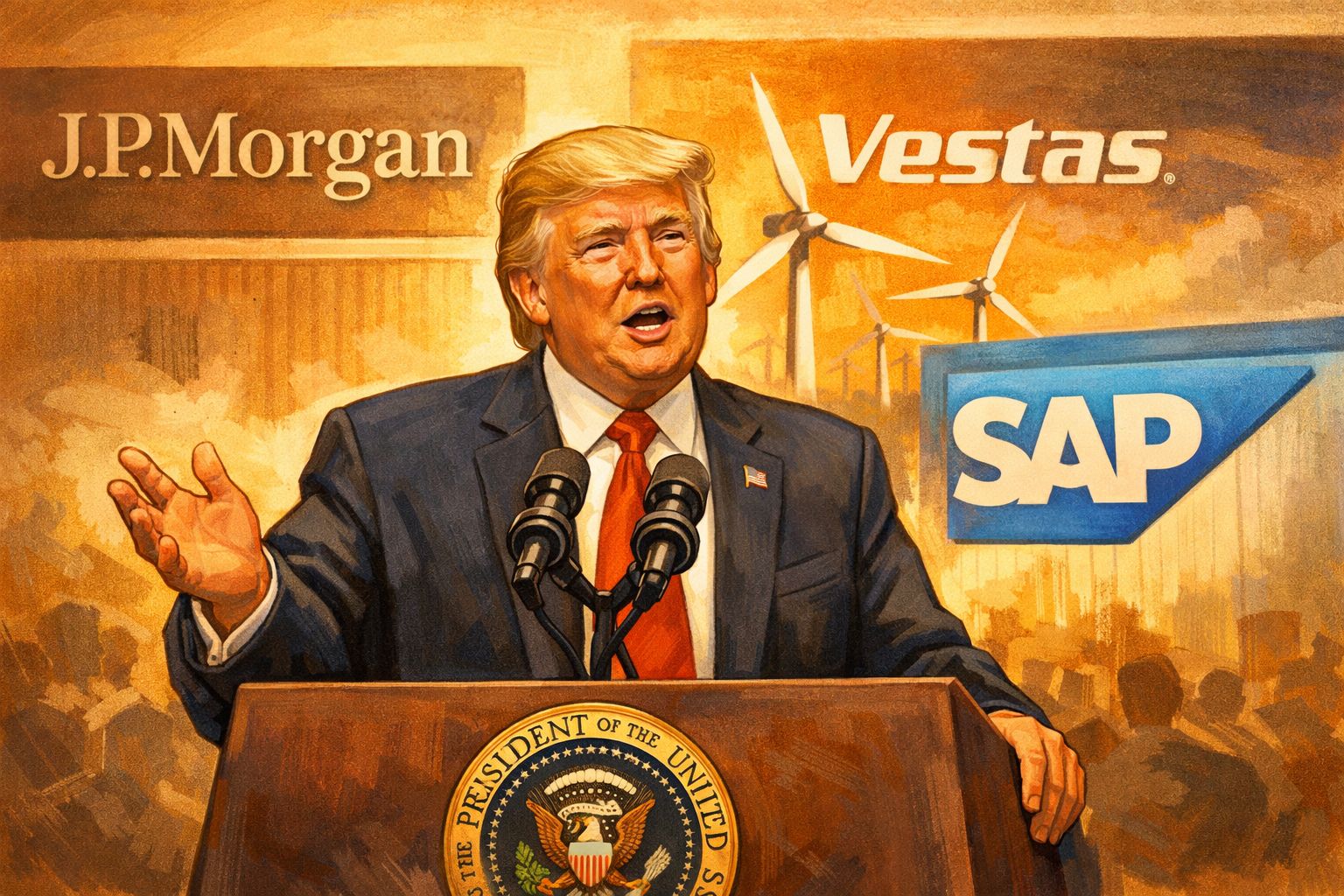
Top corporate leaders expressed relief after US President Donald Trump stepped back from imposing new tariffs on Europe, but warned that geopolitical uncertainty and regionalization remain central concerns for global business.
Speaking to CNBC on the sidelines of the World Economic Forum in Davos, executives said the easing of immediate trade tensions had lifted markets, yet companies are still prioritizing resilience amid an unstable global environment.
JPMorgan’s European head praised Europe for taking a strong and coordinated stand against Trump while dealing with Greenland.
JPMorgan co-CEO calls for coordinated stance against Trump
Conor Hillery, JPMorgan’s co-CEO for Europe, told CNBC that European leaders’ tougher, more coordinated stance toward Trump was “very good for business.”
“It’s more cohesion among European leaders, more policy driven towards business growth, stability, innovation, investment, and so forth. What you’ve seen over the last few days has obviously been more focused on Greenland and tariffs and so forth, and it has borne fruit,” Hillery said on “Squawk Box Europe.”
He described the past year as a “roller coaster” since Trump returned to the White House, adding that while anxiety remains high, there is still confidence in the macroeconomic and corporate outlook.
“There still is a feeling of resilience and some kind of confidence” despite “high degrees of anxiety about where the world is going,” he said.
Trump said on Wednesday that he and NATO Secretary General Mark Rutte had agreed on a “framework of a future deal” involving Greenland, and confirmed he would not proceed with 10% tariffs on eight European countries that had resisted his push.
The announcement sparked a rebound in European markets, with auto-related stocks leading gains, reflecting the sector’s sensitivity to tariffs due to global supply chains and US manufacturing exposure.
Businesses brace for geopolitical volatility
SAP CEO Christian Klein said clients remain focused on how to manage unpredictable geopolitical developments, particularly as tariffs and regionalization affect global trade.
SAP operates globally, but Klein said he felt “bad” for European startups, pointing to the lack of a digital union in Europe, which makes scaling more difficult and reduces resilience.
He urged European leaders to deregulate and encourage risk-taking, arguing that artificial intelligence could help businesses build stronger competitive moats.
Trump described the Greenland framework as more of a “concept” in an interview with CNBC’s Joe Kernen.
He said it could involve US-European collaboration on a proposed Golden Dome missile defense system and access to mineral resources in Greenland.
Localization and market sensitivity remain key themes
Henrik Andersen, CEO of wind energy company Vestas, said his firm has localized its supply chain, pushing back against Trump’s claims that China dominates green energy infrastructure exports.
“We have factories that produce, in most major markets, turbines for that market based on local components,” Andersen told CNBC, adding that sourcing is done locally in the US, Europe, and Denmark.
Before Trump backed down on tariffs, Wolf von Rotberg, equity strategist at J. Safra Sarasin Sustainable Asset Management, said markets had learned how to interpret Trump’s negotiating style.
“His initial proposals and demands are always an opening gambit… He does not really chicken out, but his strategy requires him to retreat from his maximalist position over time,” von Rotberg said.
He added that investors understand Trump is “very much focused on markets” and sensitive to falling stock prices, helping explain the relief rally following the tariff reversal.
While immediate tensions have eased, executives at Davos signaled that resilience, localization, and strategic flexibility remain essential as geopolitical risks continue to shape the global business landscape.
The post European JPMorgan chief says standing up against Trump good for business appeared first on Invezz
