I have lived in Venezuela for nearly thirty years, through blackouts, protests, shortages, and currency resets that have come to feel like the seasons — inevitable, cyclical, and beyond our control.
But last weekend was unlike anything I have ever witnessed. It was a night that cleaved time into a before and after — for Caracas, for Venezuela, and for those of us who have called this fractured city home.
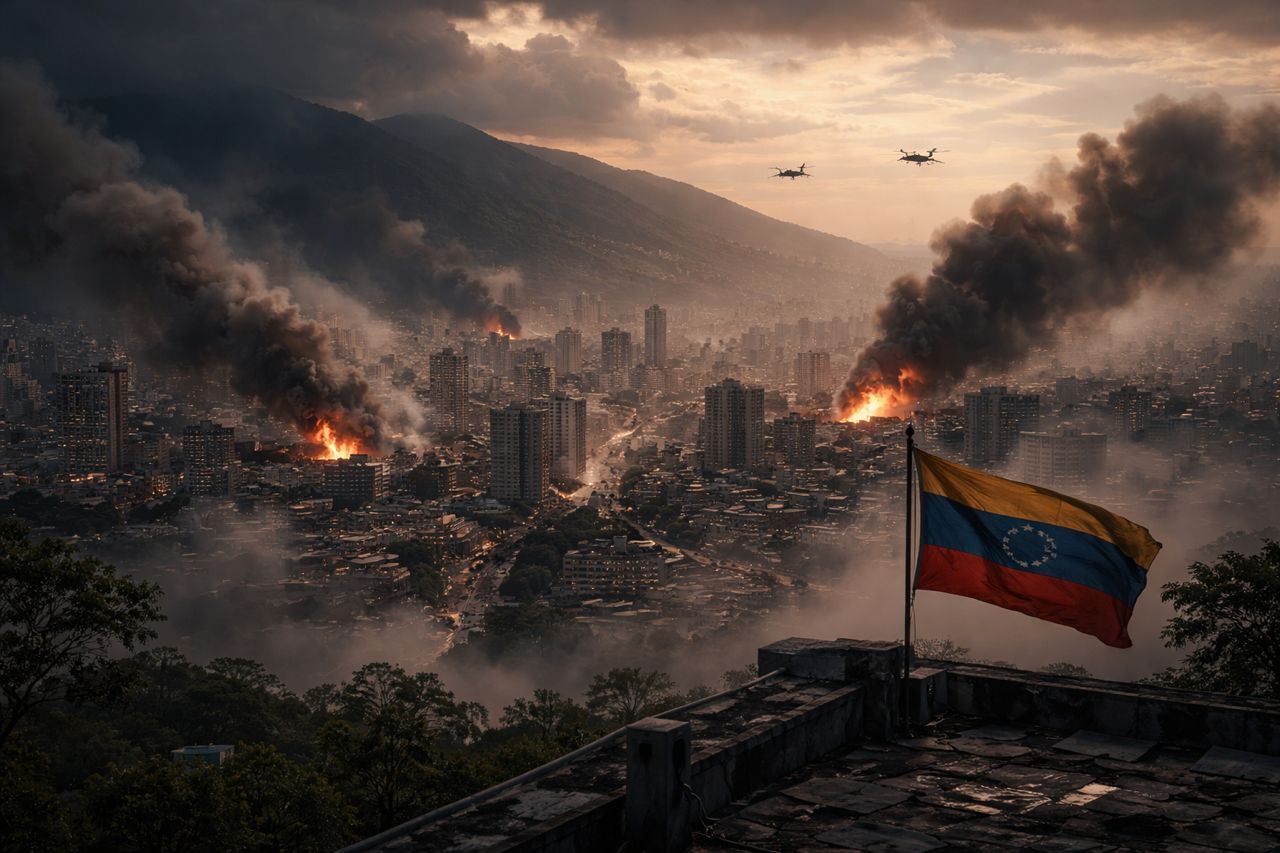
From my apartment balcony in the eastern hills, I watched the skyline pulse with distant flashes and heard a sound that every Venezuelan instantly recognises but never wishes to confirm — explosions.
The first wave of detonations came just after two in the morning on Saturday, January 3.
At first, many of us clung to an illusion — perhaps leftover fireworks from New Year’s festivities.
My dogs, usually fast asleep beside me at that hour, began barking frantically. My phone lit up with messages — ¿Lo escuchaste? What’s going on? — and by the time I reached the terrace, low-flying aircraft hummed above the city.
Soon, reports trickled in through Telegram channels and encrypted chats. What began as speculation quickly hardened into fact: seven strategic military installations across the country had been hit in coordinated airstrikes.
The targets included Fort Tiuna — the heart of Venezuela’s armed forces; La Carlota airbase, a relic and symbol in central Caracas; and the port of La Guaira, a lifeline for imports.
Rumour, disbelief, and the American shadow
By dawn, social media had become a battlefield of its own. Some voices claimed the attack marked the outbreak of a coup; others floated the unthinkable — that the United States had initiated direct military action.
For years, Washington’s influence had been felt through sanctions, diplomatic pressure, and financial isolation.
But on the morning of January 4, disbelief gave way to confirmation.
On his Truth Social platform, US President Donald Trump announced that American forces had carried out “precision operations” in Venezuela, confirming the capture of Nicolás Maduro and First Lady Cilia Flores.
Within hours, he declared that the US administration would oversee a “stabilisation transition” led jointly by Secretary of State Marco Rubio and Venezuela’s vice president, Delcy Rodríguez — a surprising choice given her long alignment with Chavismo.
The economic heart of the storm
The prospect of tapping Venezuela’s vast oil riches — home to the largest reserves on Earth and just a short voyage from the refineries of the US Gulf Coast — has long tempted giants such as Exxon Mobil, Chevron, and ConocoPhillips.
Yet for decades, the country has been a graveyard for foreign investment, plagued by corruption, expropriation, and recurring nationalisations that wiped out billions in private capital.
US sanctions deepened the decline, curtailing exports and leaving output hovering near one million barrels per day — less than a third of its 1970s peak.
That, however, may soon change — at least according to Trump.
“We’re going to have our very large United States oil companies — the biggest anywhere in the world — go in, spend billions of dollars, fix the badly broken infrastructure — the oil infrastructure — and start making money for the country,” he declared at a press conference.
The markets responded instantly.
Chevron, the only US major still operating in Venezuela under a sanctions waiver, surged as much as 6%, while Exxon Mobil and ConocoPhillips climbed in tandem. Houston-based oil-field services company SLB Ltd jumped 12%.
For now, exports remain uncertain amid confusion over who controls the industry and how payments are handled.
Trump has promised to “revive Venezuela’s broken oil system” and unlock its 303 billion barrels of reserves, but experts warn the path forward is steep.
Francisco Monaldi, director of Latin American energy policy at Rice University, estimates that Venezuela’s decrepit infrastructure may require as much as $100 billion — and a full decade of work — to approach former production levels.
Much of the country’s crude is heavy and tar-like, highly prized by complex US refineries but extremely costly to extract and process.
Even under a best-case scenario, recovery will demand not just money, but stability, expertise, and time.
Caracas after the attack
Caracas — a city of car horns, street vendors, and loud resilience — has fallen into an uneasy quiet. Supermarkets were besieged before sunrise.
I found myself queuing with hundreds of others, hoping to secure fast-disappearing food supplies even as prices soared. Electricity cut in and out. The internet slowed to a crawl.
By Monday, Venezuelans were stockpiling cash, water, and fuel as rumours spread of impending curfews.
From my window, I could see security convoys patrolling alongside civilians in colectivos uniforms — pro-government militias that have served as both defenders and enforcers during past crises.
Random checkpoints multiplied. Phones were confiscated. Conversations grew cautious.
For journalists, old dangers resurfaced with new urgency. Ten independent radio and digital outlets were blocked within 24 hours of the attack.
At least fourteen local and foreign reporters were detained during the swearing-in of Delcy Rodríguez as interim president inside the National Assembly.
They were later released, but the message was clear: narrative control now ranks above truth.
Information has always been the most contested resource in Venezuela — more volatile than oil and more elusive than dollars.
During the blackout years of 2019 and 2020, we learned to report by candlelight and VPN; today, journalists work behind encrypted firewalls, knowing that each step toward accuracy carries personal risk.
“Silence is survival,” one colleague texted me. For many, it is not just a phrase — it is a procedure.
The country’s mood and fragmented leadership
On paper, Venezuela’s leadership has shifted. The United States claims it has dismantled the Maduro regime.
Yet behind the optics of liberation lies continuity. Senior officials from the old government — Defence Minister Vladimir Padrino López, Interior Minister Diosdado Cabello, and the Rodríguez siblings — remain central figures in the so-called transition.
To many Venezuelans, this feels less like a transformation and more like a reshuffling under foreign supervision.
The population is split. Some welcome international oversight, hoping it will unlock frozen assets, reopen export markets, and stabilise inflation that exceeded 400% in 2025. Others see betrayal — sovereignty bartered for stability, democracy outsourced to Washington.
These divisions run deep. Chavismo, for all its failures, forged a political identity rooted in defiance.
Now, amid new power brokers and old scars, people are unsure whether to celebrate or mourn. The jokes have grown darker: “We changed governments, but not guards.”
Political expression walks a tightrope. Small protests have emerged in downtown Caracas, calling for Maduro’s return or for US withdrawal, but they are swiftly dispersed.
Most resistance now takes quieter forms — digital self-censorship, whispered sarcasm, or migration.
Nearly one in three Venezuelans lives abroad, forming one of the world’s largest refugee populations. Their view of home oscillates between cautious optimism and exhaustion.
“At least something is changing,” a friend in Bogotá told me. “But why must every change start with destruction?”
The road ahead
Economists describe the moment as a reset — painful but potentially catalytic. Oil production, which collapsed below 700,000 barrels per day in late 2025, could double within 18 months if US investment returns.
A restored PDVSA-Chevron partnership has already surfaced in Washington hearings.
Still, experts warn that recovery will require more than capital.
Venezuelan economist Aldo Contreras argues that credible fiscal policy, independent central banking, and transparency will determine whether this intervention leads to renewal or relapse.
Without deep reform, oil profits will once again vanish into the same networks of inefficiency and patronage that impoverished a nation of abundance.
For ordinary Venezuelans, macroeconomic indicators matter only when they translate into food, medicine, and wages.
Today, an average family still needs more than 250 times the monthly minimum salary to meet basic needs.
Aid agencies caution that any shock — logistical delays, panic buying, or renewed sanctions — could quickly spiral into widespread hunger.
As I write this, the city hums faintly outside, too quiet for Caracas. I can still picture the flashes from that night, unreal at first, then all too real. To witness such an event from close range is to realise how thin the distance is between global politics and the space where you sleep.
I have covered blackouts, protests, and hunger queues. But watching a superpower’s intervention unfold over my city felt different — at once historic and intimate, terrifying and clarifying.
The post Chronicles of Caracas from the ground: blackouts, blasts, and empty shelves appeared first on Invezz
